
Scott County Court Records After Arrest
A Scott County jail arrest is first processed through booking, identification, classification, and the county roster. The formal court record is separate. It opens when a complaint, information, indictment, citation, or other filing reaches the court system. Iowa Courts Online then becomes the main public route for court records after a jail arrest, while the jail roster remains the custody and booking source.
That split matters because jail charges can change. The booking record may show the arresting or committing agency's charge language. The Scott County Attorney's Office, led by County Attorney Kelly G. Cunningham, reviews and prosecutes indictable crimes, non-indictable offenses, juvenile matters, and other cases within its duties. Charges may be amended, reduced, dismissed, added, or replaced once court review starts. Use jail inmate records for custody and booking data, and use jail roster mugshots for booking-photo questions.
Find Scott County Court Records
The official public docket portal is Iowa Courts Online. Public trial court docket access is available without a subscription. The help documentation says public cases after 1998 are generally online, while older cases may require the clerk. Advanced case search and schedule search are registered paid tools, and electronic documents can require a courthouse public access terminal in the county where the case was filed.
- Search the Scott County jail roster if current custody, booking date, agency, or roster charge language is needed first.
- Open Iowa Courts Online and search by defendant name, case ID, citation number, or other available mode.
- Narrow by Scott County, date of birth, case type, or case number when common names produce too many results.
- Open the docket and compare filed charges to the jail-booking charge descriptions.
- For court date, time, and room questions, call the Scott County Clerk of Court traffic/criminal contact at 563-326-8787.
The Iowa Courts Online entry page is the statewide search point for Scott County court records after a jail arrest.
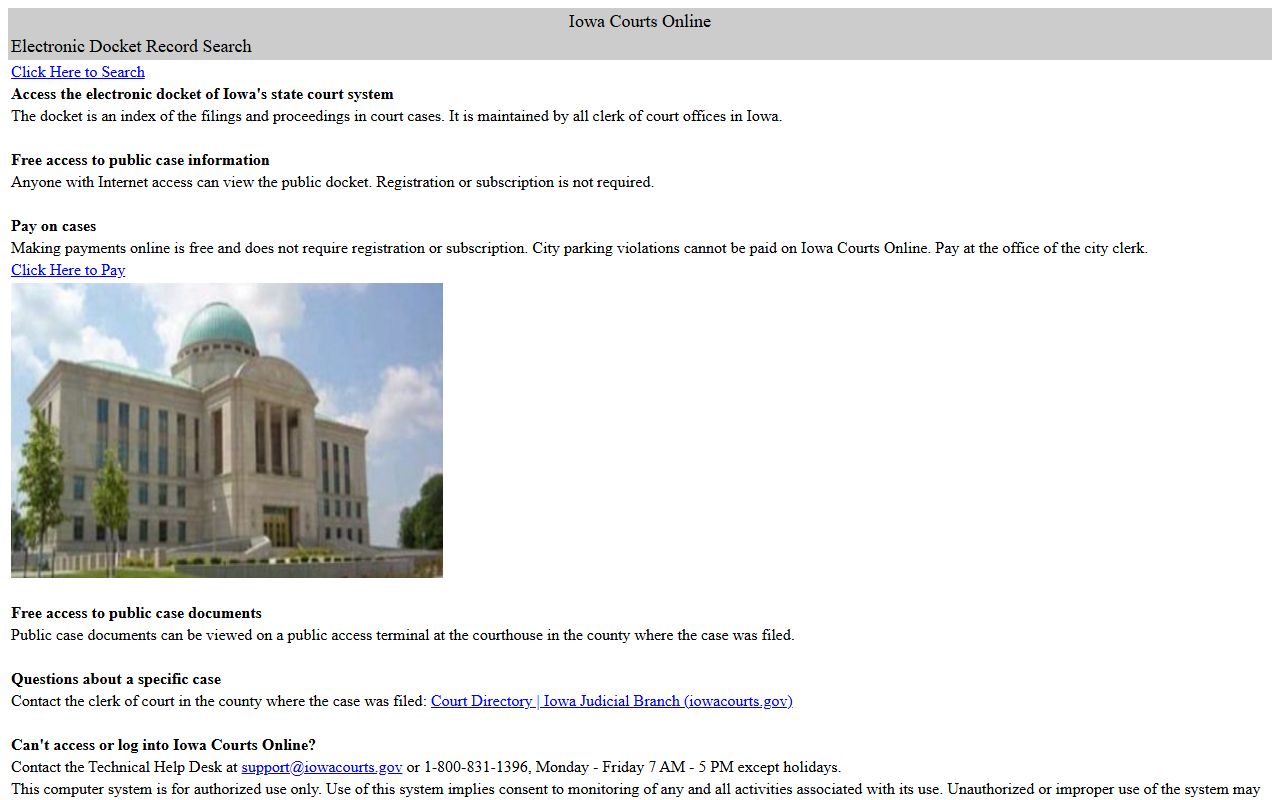
The court portal is used for case records, not jail mugshots or jail housing status.
Scott County Court Search Fields
Iowa Courts Online offers several public and registered search paths. For a recent jail arrest, a name search is common, but a case ID, citation number, or date of birth can help avoid mistaken matches.
| Field or Mode | Type | Required | Notes |
|---|---|---|---|
| Trial Court Case Search | Public search path | Optional path | Statewide public docket search. |
| Last/Firm Name | Text | Yes for name search | At least two letters; wildcard percent sign allowed. |
| First Name | Text | Optional | No period after an initial. |
| Date of Birth Search | Name and date mode | Conditional | Exact DOB; required names cannot use wildcard. |
| County | Dropdown | Required for case ID mode | Choose Scott for local cases. |
| Case Type | Dropdown | Required with case ID | Criminal abbreviations include FE, AG, SR, SM, OW, ST, NT, and CR. |
| Citation Number | Text | Optional mode | Use when a citation number is known. |
Charges After a Scott County Arrest
Court records after a jail arrest depend on the charging document. Iowa Code 804.1 allows criminal proceedings to begin by filing a complaint before a magistrate. Iowa Code 801.4 defines a complaint as a written sworn accusation. Iowa Code 331.756 includes county attorney duties such as preparing informations and bills of indictment. The words in the jail roster and the words in the court case may not match exactly after this review.
| Document | Who Uses It | What It Does |
|---|---|---|
| Complaint | Officer, prosecutor, or authorized complainant | Starts a criminal accusation before a magistrate or clerk/designee. |
| Information | County attorney | Formal prosecutor filing that states the charged offense. |
| Indictment | Grand jury process | Formal accusation used in serious cases when the grand jury route applies. |
Once a filing exists, the court docket is the better source for charge status, hearing dates, and disposition. The jail roster is still useful for custody, bond table fields, VINE links, and the booking timeline.
Initial Appearance After Arrest
Scott County's initial appearance page states that new state-charge arrests generally appear before a judge within 24 hours of booking. Regular business-day initial appearances occur at the Scott County Courthouse, and weekend or holiday appearances use a Zoom virtual process. The court can address release, remand, bond, and next court steps, while the prosecutor's filed charges determine the court record.
The Scott County initial appearance page shows the county's timing and remote hearing details.
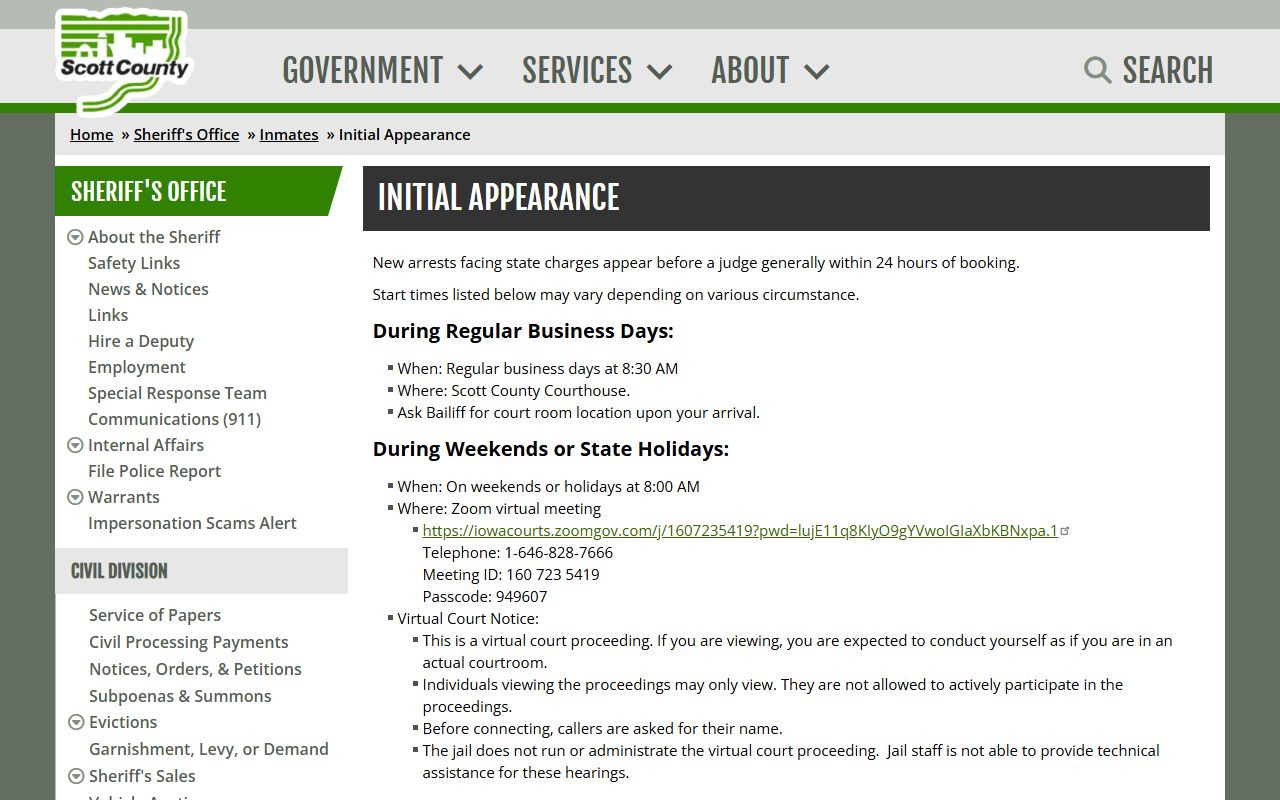
This stage often explains why a new booking has roster details before a full court record appears online.
Scott County Charge Status
A charge listed after a Scott County arrest is an accusation until the court reaches a disposition. A prosecutor may amend a charge, reduce it, add another count, dismiss it, or pursue it to plea, trial, deferred judgment, or sentencing. A case can also have multiple charges moving at different speeds.
| Status | Plain Meaning |
|---|---|
| Pending | The charge is active and no final disposition is shown. |
| Amended | The charge language, level, or count has changed by court filing. |
| Reduced | The case moved to a lesser charge or lower level. |
| Dismissed | The charge was ended by court action, usually without conviction on that count. |
| Convicted | The record shows a guilty plea, verdict, or other conviction disposition. |
Bond After a Scott County Arrest
Scott County publishes jail bond-payment instructions. Cash bond may be paid in cash, by credit or debit card, or through a bail company where allowed. Online and phone card payments use GovPayNet or GovPayNow, and the county lists the information needed as inmate name, date of birth, and case number. The roster bond table can show no-bond or unbondable status, so not every booking has a payable release bond.
| Bond Type | How It Works in Scott County |
|---|---|
| Cash bond | Can be paid at the jail or court channel; in-person cash has no county service fee. |
| Credit or debit | GovPayNet/GovPayNow service fees apply, including a minimum flat fee and percentage fee. |
| Bail-company bond | The county lists a bond posted by a bail company as an option where allowed. |
| No-bond hold | A court order, detainer, parole or probation hold, federal matter, or ICE issue may block release. |
Warrants and Scott County Arrest Records
Scott County has an official warrant hub and advanced warrant search. The county warns that a warrant is an accusation, not proof of guilt, and that arrest without disposition is not an indication of guilt. The warrant search can include name, warrant number, charge, date range, recent jail checkbox, status, and sort order. If a person surrenders on a warrant, the warrant FAQ describes reporting to the Clerk of Court's Office on the first floor between 0800 and 0900 hours, then being escorted by a sheriff's bailiff for court handling.
The Scott County warrant search form is useful when a missed court date or warrant may have led to the arrest.
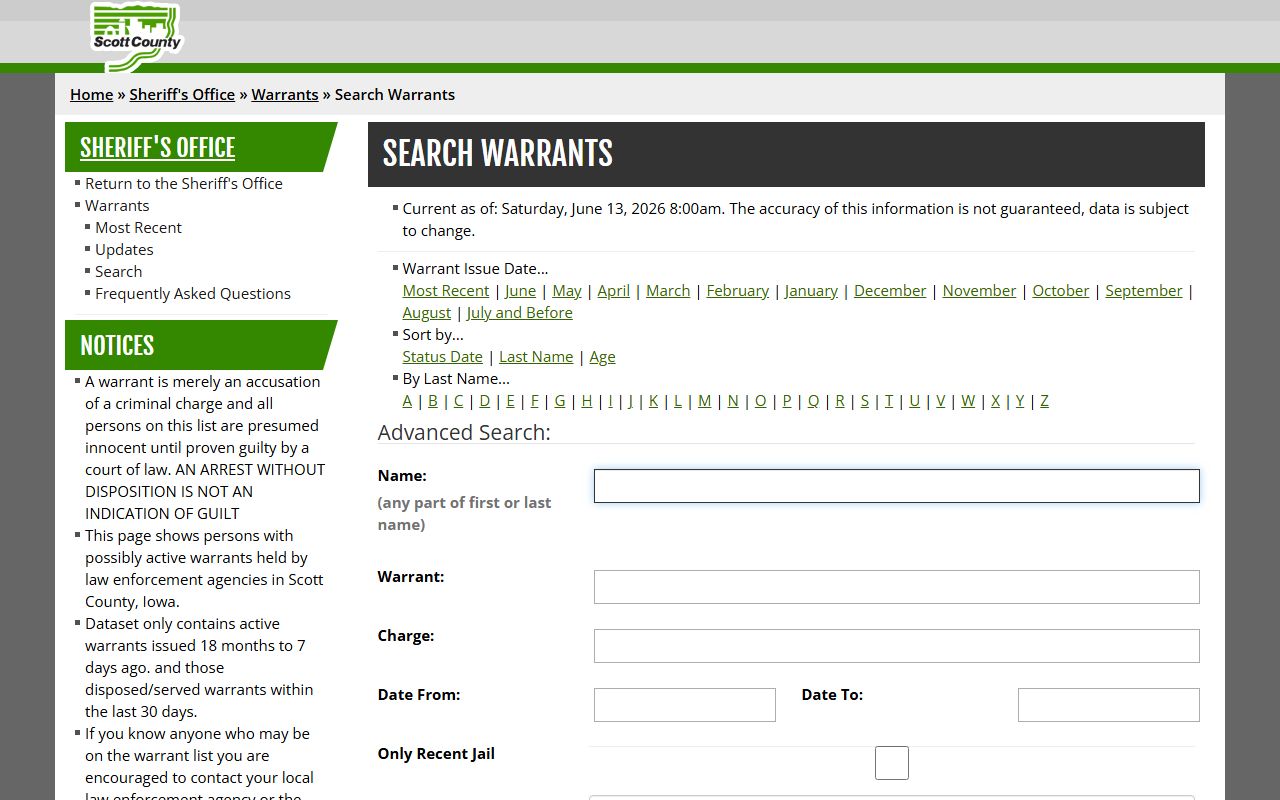
Warrant records should be read with the same care as booking records because both are accusation-stage records until the court resolves the case.
Charges vs Convictions
Scott County court records after an arrest can show accusations long before they show outcomes. A charge means the government alleges an offense. A conviction means the court record shows a guilty plea, verdict, or equivalent conviction result. Dismissed charges, amended counts, and deferred outcomes require careful reading.
| Charge | Conviction | |
|---|---|---|
| Stage | Accusation in a case | Final or case-level guilt finding |
| Proof | Not proof of guilt | Based on plea, verdict, or court finding |
| Where to confirm | Iowa Courts Online docket and filings | Final docket entry, judgment, or clerk record |
Sealed and Expunged Records
Iowa law restricts some records. Juvenile and confidential matters are not public in the same way as ordinary adult criminal cases. Iowa Code 901C.2 allows eligible dismissed or acquitted criminal cases to be expunged under conditions, and expunged records become confidential and exempt from public access. Iowa Code 692.2 also limits release of certain criminal-history data, including older arrests without disposition and some deferred-judgment data without proper authorization.
| Sealed or Confidential | Expunged | |
|---|---|---|
| Public view | Hidden or restricted from ordinary public access. | Made confidential under the expungement order and statute. |
| How it happens | By statute, court rule, case type, or court order. | By eligible court process after dismissal or acquittal. |
| What to do | Ask the clerk or an attorney about access limits. | Use the court process, not a mugshot site or informal request. |
Important: Court records after arrest are not consumer reports and must not be used for FCRA-covered screening decisions.
Public Record Search
Sponsored Results